The Logarithmic Spiral
Panel 03 gave us eiθ, a point that only ever turns. Add a real number to the exponent and the circle springs a leak: the point keeps turning, but now it grows as it goes. A single constant sets how tightly it winds, and the same equiangular curve turns up in nautilus shells, spiral galaxies, hurricanes, and the seed head of a sunflower.
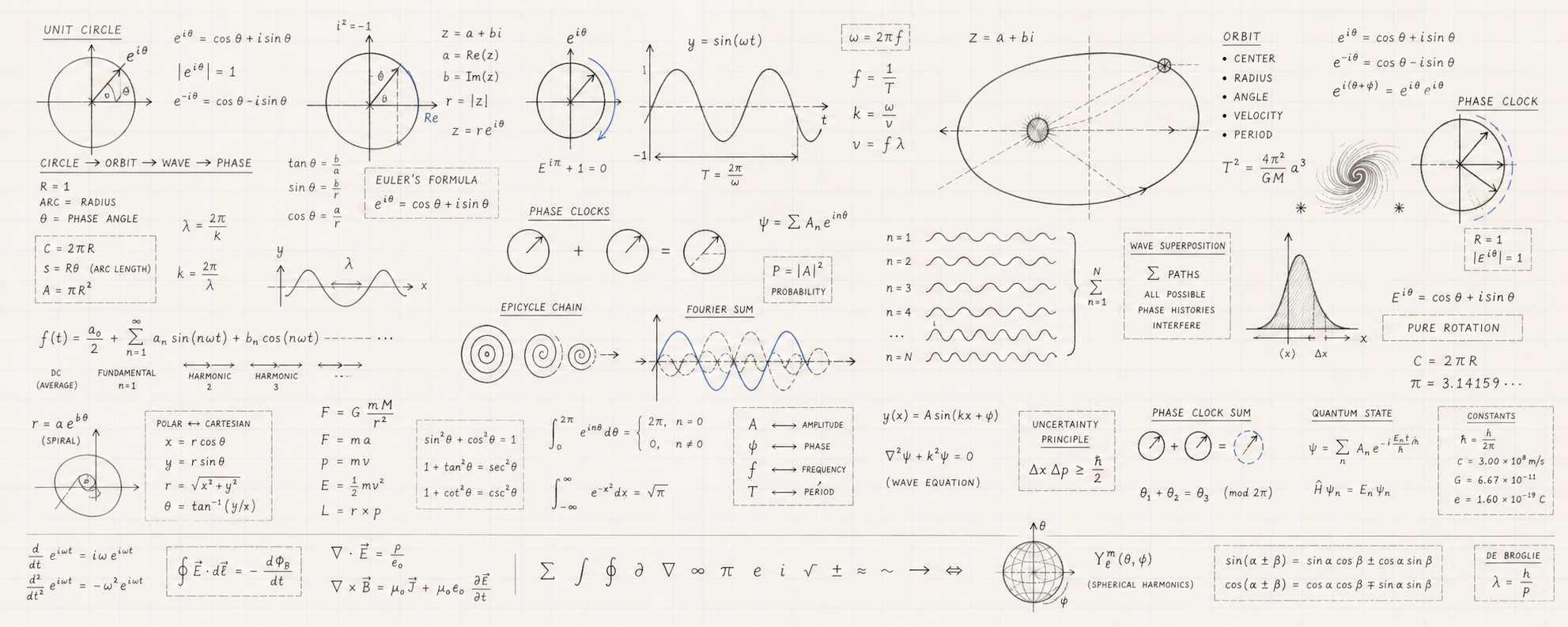
Take the rotating point from panel 03 and let its exponent carry a real part too: z(t) = e(a+bi)t. The imaginary part b spins it; the real part a scales it. Split into size and direction and the two motions come apart cleanly.
Written in polar form, the radius is just an exponential of the angle. One number k = a/b — the growth per radian — decides everything about the shape. At k = 0 the radius never changes and you get a plain circle; nudge it up and each full turn multiplies the radius by the same fixed factor, e2πk.
Here is the property that makes this spiral special. Draw the straight line from the origin out to any point on the curve, then draw the curve's tangent at that point. The angle between them is the same at every point on the spiral, which is why it's also called the equiangular spiral.
That constant angle is the whole secret to its self-similarity: zooming in on a logarithmic spiral gives you back the very same spiral, just rotated. Growth and rotation become interchangeable — scaling the picture is identical to turning it. No other spiral does this, and it's exactly the trait a growing shell or galaxy needs: get bigger without changing form.
Unroll the spiral the way panel 02 unrolled the circle — track only the horizontal shadow of the moving point — and the exponential envelope rides straight through into the wave.
With a < 0 the spiral winds inward and the shadow is a ringing that dies away — a plucked string, a struck bell, the current in an RLC circuit. With a = 0 it's the steady sine wave of panel 02. With a > 0 it runs away: the runaway growth of feedback and resonance. Growth and rotation, read off one axis at a time.
A sunflower drops each new seed at a fixed turn from the last one, and pushes the earlier seeds outward as it grows — a rotation plus steady expansion, the exact recipe for a logarithmic spiral. The only question is the turn angle.
Pick almost any angle and the seeds line up in wasteful radial spokes. Pick the golden angle, ≈137.5° — the most irrational turn there is, built from φ and cousin to the π of panel 04 — and no two seeds ever fall on the same ray. The packing is as dense as it can be, and the curved parastichy spirals you see are always consecutive Fibonacci numbers. Try nudging the angle by a fraction of a degree and watch the order collapse.