Feynman's
Rotating Clocks
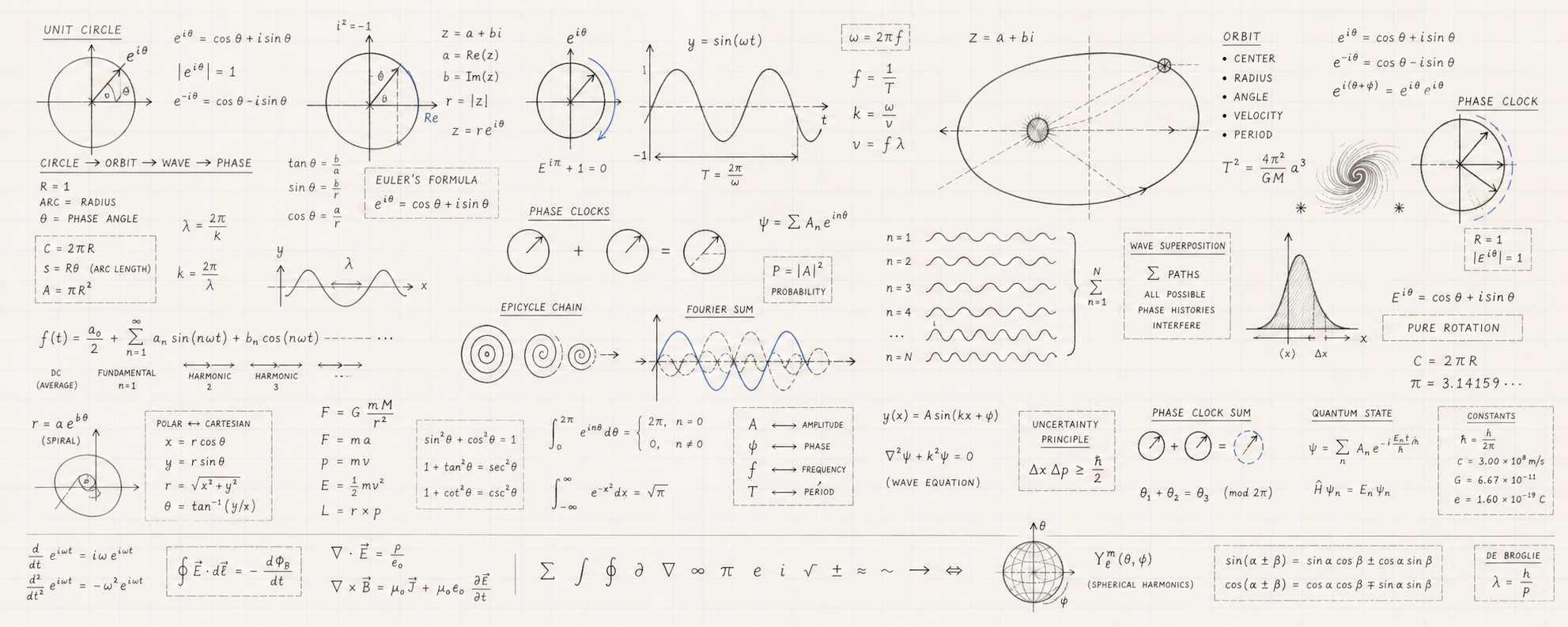
Richard Feynman explained quantum electrodynamics with literal clock hands: draw a tiny spinning arrow for every possible path a particle could take, add all the arrows together, and the length of what's left tells you the probability. It's panel 02's rotating exponential, turned into a method for predicting how light actually behaves.
Light bouncing off a mirror looks like it takes one path, the one where the angle in equals the angle out. Feynman's method says it actually explores every bounce point at once. Each candidate path gets a clock hand set spinning at a rate fixed by how long that path takes.
Bounce points far from the "obvious" reflection point have wildly different path lengths from their neighbors, so their clocks point every which way and mostly cancel when added. Near the shortest path, path length barely changes from one point to the next, so those clocks stay nearly aligned and add up to something real. That's why the mirror seems to obey a single simple rule, it's really a landslide vote among nearby paths.
In panel 01 the clock angle came from path length divided by wavelength, light's stand-in for a deeper quantity called the action, S. Feynman's path integral sums eiS/ħ over every conceivable trajectory a particle could take through space and time, not just light bouncing off a mirror. Page 03's ψ(t) = ψ(0)·e−iEt/ħ is what falls out of that sum for a particle sitting in one definite energy state: a single path, spinning at one steady rate, because there's nothing left to average over.
Schrödinger's equation and Feynman's sum-over-paths were proven to be the same theory, written two different ways, arrows added all at once versus a single wave evolving smoothly. Zoom out far enough and even ordinary classical motion, a thrown ball, a swinging pendulum, is this same landslide vote: nearly every path cancels itself out except the one obeying Newton's laws.
Send a particle through two slits and there are exactly two paths to sum: through slit one, or through slit two. Each contributes one clock arrow, its angle set by that path's length to the detector. Where the two arrows land pointing the same way, they add up to something big, a bright fringe. Where they land pointing opposite ways, they cancel to nothing, a dark fringe.
No path "knows" about the other slit. The interference pattern is just what two spinning clocks look like when you add them and square the result, the same operation running through every panel in this series.