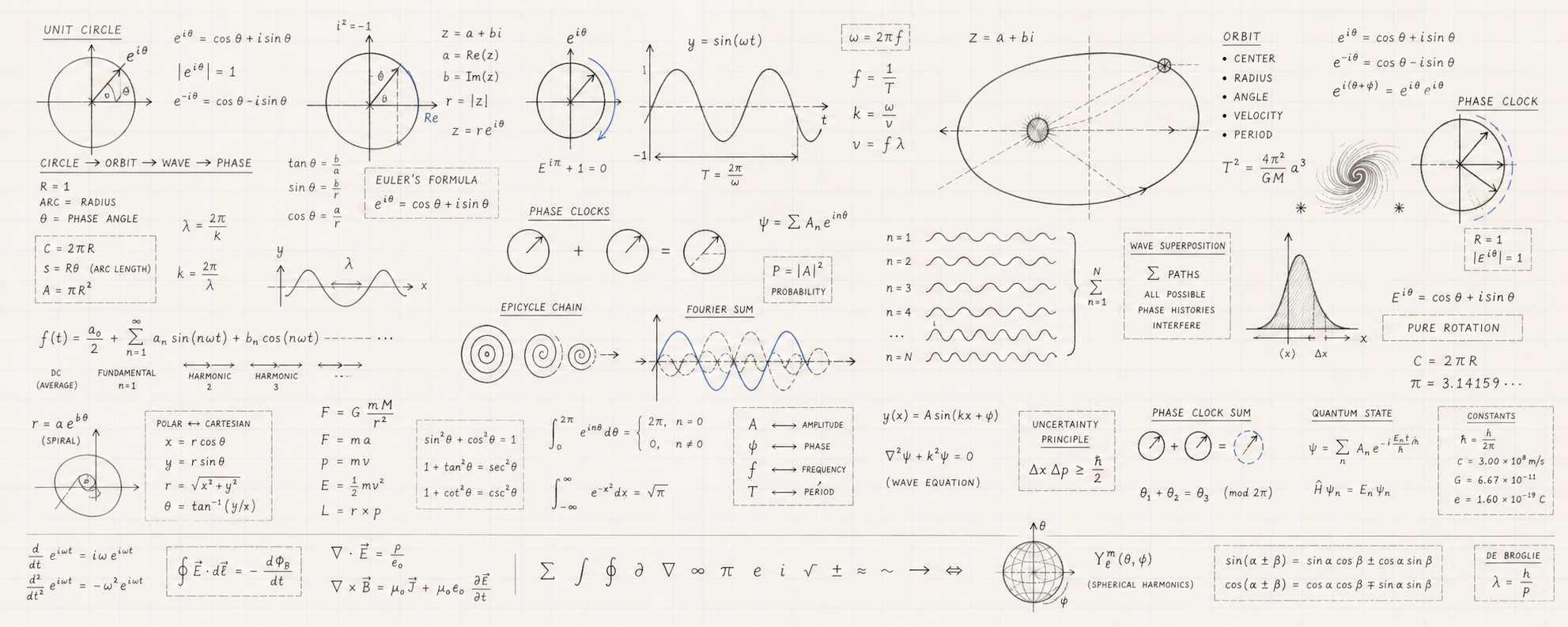
e, i, and the Long Detour
Into Quantum Mechanics
Two ideas born from unglamorous problems, compound interest and an unsolved cubic equation, turned out four centuries later to be the native language of quantum theory. Neither Cardano nor Bernoulli had any idea what they'd started.
Put $1 in an account paying 100% annual interest. Compound it once a year and you get $2. Compound it monthly, daily, by the second, and the total keeps creeping up, but not without limit. It settles on one specific number.
What actually makes e important isn't the interest problem, it's that ex is the one function whose rate of change equals its own value. Anything that grows or decays in proportion to how much of it there already is, populations, radioactive decay, capacitor voltage, is secretly writing itself in terms of e.
This cubic has three ordinary, real, solutions: 4, and −2±√3. No mystery there. But Cardano's own formula for solving cubics, applied to this equation, produces an intermediate step where you must take the square root of −121.
The answer at the end is completely real. The path to it isn't. Bombelli's move, in 1572, was to stop refusing that detour and just carry the bookkeeping through: let i mean √−1, follow the algebra, and trust that it would resolve itself. It did. That's the first time anyone treated imaginary numbers as usable rather than nonsensical.
The geometric picture, arriving two and a half centuries after Bombelli, is what finally made i feel like a real object instead of a trick. Multiplying a number by i doesn't stretch or shrink it, it rotates it 90° on the complex plane.
Four multiplications, one full turn. That's the entire content of "imaginary": a name for the operation of turning.
ex is defined by an infinite sum: 1 + x + x²/2! + x³/3! + … Feed in x = iθ instead of a real number, and each term becomes a little arrow in the complex plane, its length shrinking fast thanks to the factorial, its direction cycling through the four quarter-turns from panel 03.
Chain those arrows tip to tail and watch where they land. At θ = π they walk, term by term, straight to the point −1.
Growth (e), rotation (i), and the circle (π) turn out to be one and the same idea, viewed from three different centuries of mathematics.