Circle → Wave →
Fourier → Schrödinger
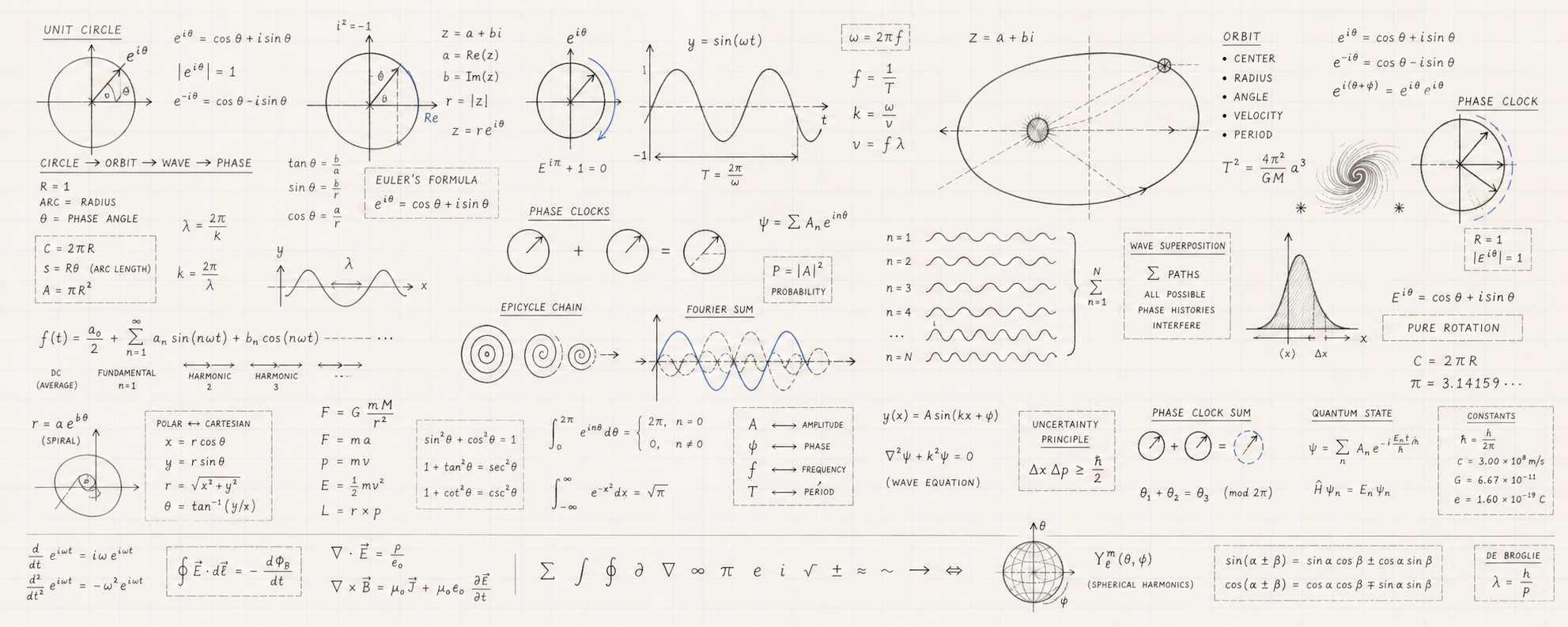
The same rotating point that measures radians also generates every sine wave, builds up arbitrary signals in a Fourier series, and describes how a quantum state's phase evolves in time. One picture, four names.
Spin a point around a circle at a steady rate and just watch its height. That single number, rising and falling, is a sine wave. Its side-to-side shadow is a cosine wave, exactly the same motion, a quarter turn out of phase.
A "wave" isn't a separate kind of object from a circle. It's a circle viewed edge-on, with time doing the unrolling.
All four functions are measurements of the same rotating point, just read off in different places. Sine and cosine are the shadows from panel 01. Tangent and cotangent are lengths, measured on lines that just touch the circle rather than pass through it.
Extend the radius until it hits the vertical line touching the circle at (1,0): that intercept's height is tan θ. Extend it instead to the horizontal line touching the circle at (0,1): that intercept's distance from center is cot θ.
Tangent blows up to infinity as θ nears 90°, where cos θ hits zero, division by nothing. Cotangent does the same near 0°, where sin θ vanishes instead. Two functions, two different lines, two different ways of falling apart.
Instead of tracking a horizontal shadow and a vertical shadow as two separate stories, put the circle in the complex plane. One arrow, one equation, carries both at once. This is Euler's formula, and it's the reason complex numbers show up anywhere rotation does.
θ growing with time just means the arrow spins at a constant rate. That single spinning arrow is the building block for everything below.
Chain smaller circles onto the tip of bigger ones, each spinning faster, and their combined tip traces stranger and stranger paths. Add the right sizes and speeds and you can draw any periodic wave, including sharp-edged ones a single circle never could.
That sum, over odd n, is a square wave. This is the Fourier series: decomposing a complicated signal into a stack of pure rotations at different frequencies, and it works in reverse too, any signal can be read back off as a list of circle speeds and sizes. That reverse reading is the Fourier transform.
For a state of definite energy E, the Schrödinger equation says its phase spins at a constant rate set by E, nothing else about it changes with time.
That's the exact same rotating arrow from panel 03, just with speed ω = E/ħ instead of a generic ω. Higher energy means faster spin. Put a system in a mix of two energies and you're adding two circles at two speeds, exactly panel 04's construction, which is why superpositions beat and oscillate in time: it's Fourier synthesis, with energy playing the role of frequency.