Measure a turn
A circle gives the first unit of rotation: the radian, where the arc and radius finally speak the same language.
A story of mathematics told through one rotating point.
Begin with Euclid's clean geometry: a radius, an arc, and an angle. Follow that motion through Newton's heavens, Fourier's waves, Euler's exponential, and Feynman's clocks, where probability itself is drawn with rotating arrows.
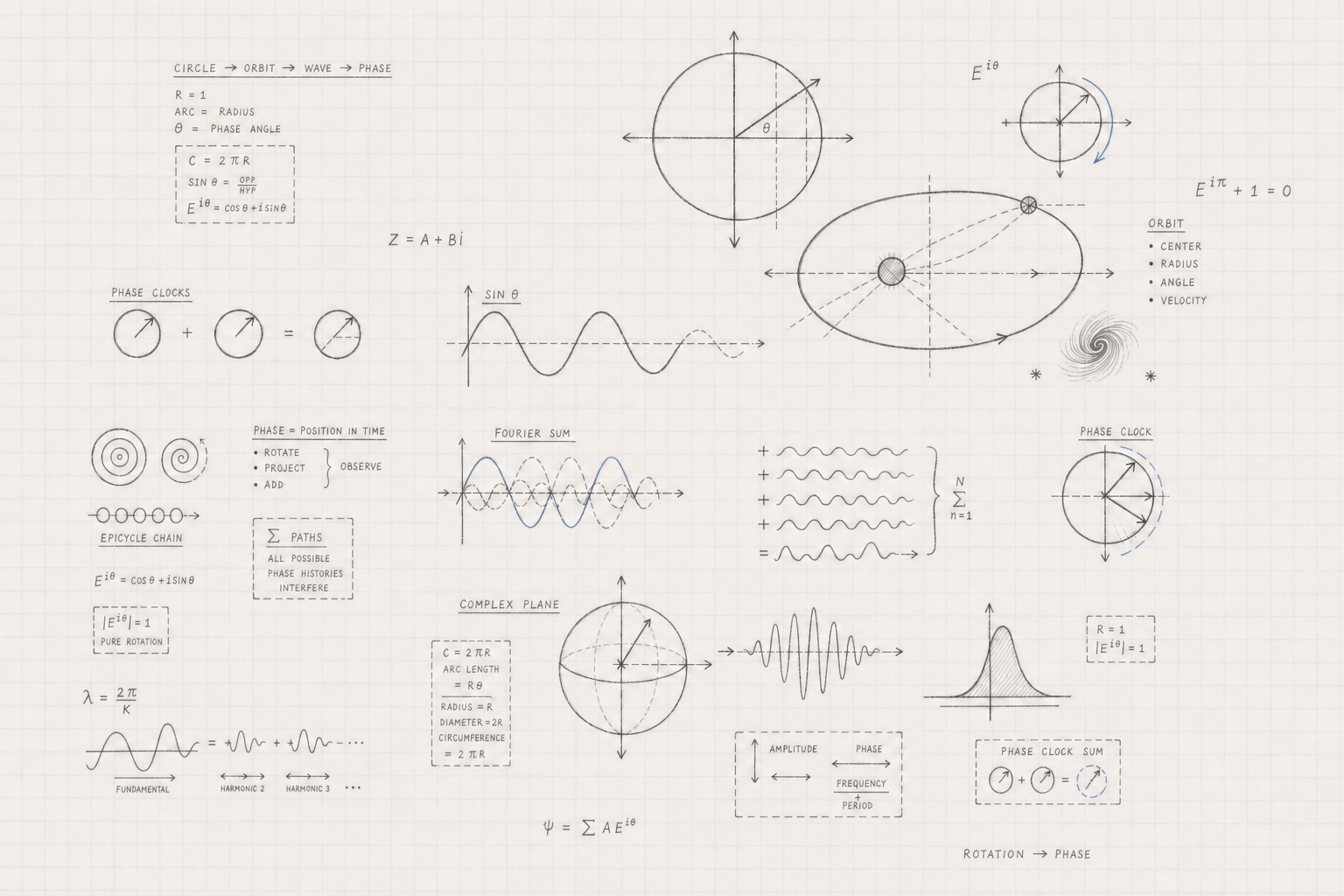
Geometry as a sketchbook. The same circle keeps reappearing: first as an angle, then as an orbit, a wave, and a quantum phase.
A circle gives the first unit of rotation: the radian, where the arc and radius finally speak the same language.
Rotating geometry becomes a way to model repeating motion, from epicycles to Newton's sweep of planets through space.
Sines, cosines, and complex exponentials turn circles into a toolkit for sound, light, heat, and quantum state changes.
Feynman's path amplitudes bring the rotating arrow back: add the little clocks, then square the result.
Each chapter is a small interactive step in the larger arc: circle, shadow, wave, spiral, phase, and probability.
Eight chapters to begin with — the series is still growing.