Epicycles — Drawing
with Rotating Circles
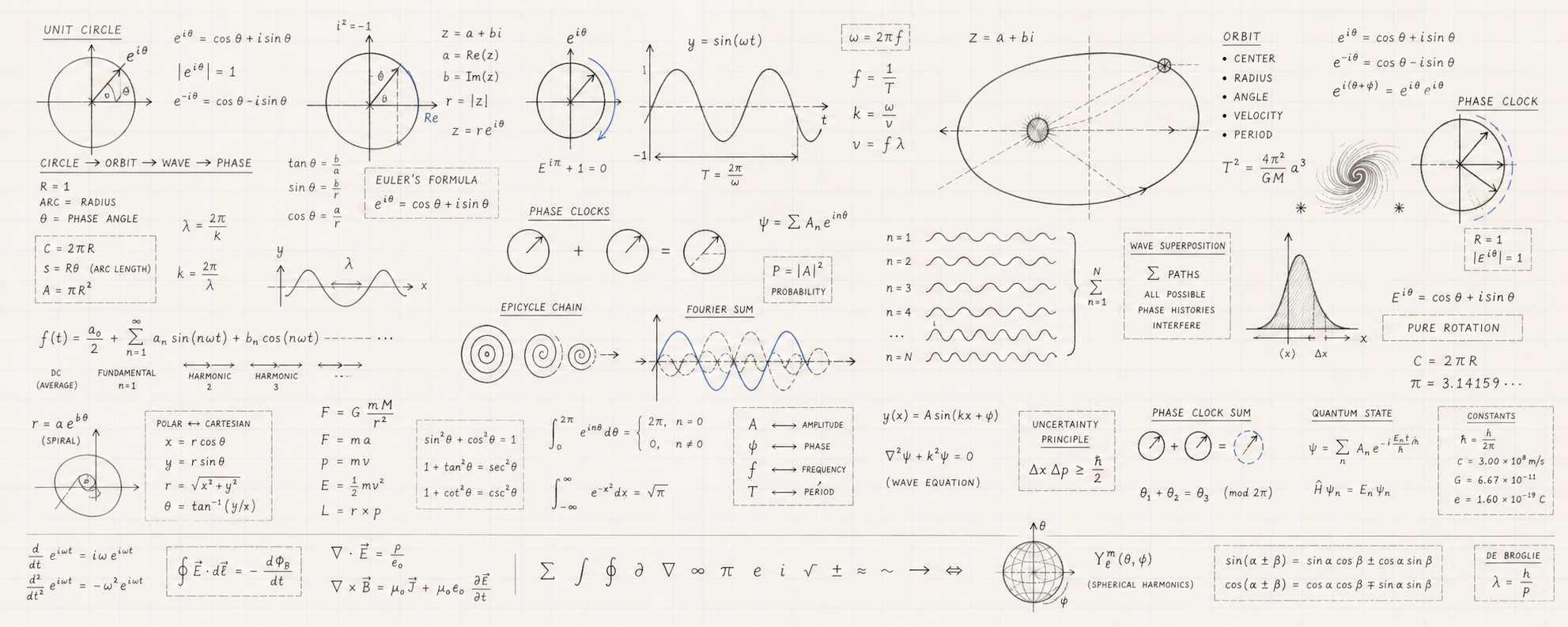
Panel 02 turned one rotating point into a wave, and panel 05 added tiny arrows together to get probability. Put those ideas together and you get the most hypnotic fact in Fourier analysis: chain up enough circles, each spinning at its own steady rate, and their tip will trace out any shape you like — a square wave, a star, a signature.
Start with panel 02's trick — a spinning arrow whose height traces a sine wave — then stack more arrows tip-to-tail, each a bit smaller and spinning a bit faster. Read off the height of the final tip and plot it against time.
A single circle gives a plain sine. Add the third harmonic, then the fifth, and the bumps flatten into shelves. With enough odd harmonics the wobble collapses into flat tops and vertical cliffs — a square wave, assembled entirely from smooth rotations.
Nothing says the arrows have to stay in a line. Let each rotate freely in the complex plane and the running tip sweeps out a 2-D curve. Any closed outline is just a complex-valued signal, and its Fourier coefficients are the recipe: one rotating vector per term.
Sort the vectors biggest-first: the largest circle blocks out the rough position, and each smaller one adds a finer wiggle. This is exactly how vector-art "draw with Fourier" toys work — and, at heart, how JPEG and MP3 store a picture or a sound as a short list of coefficients. Switch shapes and dial the count up and down.
Convergence isn't perfectly polite. Piling on harmonics squeezes the reconstruction (solid) toward the ideal square wave (dashed) almost everywhere — but right at each vertical jump a stubborn overshoot refuses to shrink.
Add more terms and the little "ears" get narrower and crowd closer to the edge, yet their height stubbornly parks at about 9% of the jump and stays there forever. This is the Gibbs phenomenon — the reason a sharp edge in an image, reconstructed from finitely many frequencies, comes back with faint ringing beside it.